Showing posts with label middle ages. Show all posts
Showing posts with label middle ages. Show all posts
Sunday, 1 July 2012


Wednesday, 30 May 2012
jaques di molay templar
 De Molay was burnt to death on the Ile de la Cite, the original Paris, in the shadow of Notre Dame Cathedral, which the Templar’s had built on a former site of worship to the goddess Diana. His death was ordered by the Roman Church Inquisition with support from King Phillipe the Fair, who could well have been under the control of the Priory of Sion.
 Sunday, 13 May 2012

Monday, 19 March 2012

Monday, 6 February 2012
SALADIN
 Ṣalāḥ ad-Dīn Yūsuf ibn Ayyūb (Arabic: صلاح الدين يوسف بن أيوب, Ṣalāḥ ad-Dīn Yūsuf ibn Ayyūb, Kurdish: سهلاحهدین ئهیوبی, Selah'edînê Eyubî) (ca. 1138 – March 4, 1193), better known in the Western world as Saladin, was a Kurdish Muslim, who became the first Sultan of Egypt and Syria, and founded the Ayyubid dynasty. He led Muslim and Arab opposition to the Franks and other European Crusaders in the Levant. At the height of his power, his sultanate included Egypt, Syria, Mesopotamia, Kurdistan, Hejaz, and Yemen.
Under his personal leadership, his forces defeated the Crusaders at the Battle of Hattin, leading the way to his re-capture of Palestine, which had been seized from the Fatimid Egyptians by the Crusaders 88 years earlier. Though the Crusader Kingdom of Jerusalem would continue to exist for a period, its defeat at Hattin marked a turning point in its conflict with the Muslims and Arabs. As such, Saladin is a prominent figure in Kurdish, Arab, and Muslim culture. Saladin was a strict adherent of Sunni Islam
His noble and chivalrous behavior was noted by Christian chroniclers, especially in the accounts of the Siege of Kerak, and despite being the nemesis of the Crusaders, he won the respect of many of them, including Richard the Lionheart; rather than becoming a hated figure in Europe, he became a celebrated example of the principles of chivalry.
Friday, 27 January 2012
HALIDON HILL
 In 1332 during an Anglo-Scots peace, Edward Balliol sailed with eighty-eight ships from the Humber to Fife and fought his way to Scone. His father John had abdicated in 1296 and Edward, claiming his family as still the true royal line, had himself crowned King of Scotland.
David II’s claim had the endorsement of the Scottish Parliament and so Sir Archibald Douglas, guardian of David II, immediately swept Edward out of the country ‘with one leg booted and the other bare’.

The puppet-king returned in 1333 leading an English army across the border and laying siege to Berwick. Edward III joined with him in the May and together their men set in upon Halidon Hill, a perfect vantage point giving command of all approaches to Berwick. Sir Archibald Douglas was in Northumberland and made for the town to relieve it.

The only means of attack for the Scots was by working their way through a bog before clambering up the hillside. As they attempted this the English archers picked off their targets at ease.

By the end of that 19 July Sir Archibald, six Scottish earls, seventy barons, five hundred knights and an unknown number of spearmen were dead, while England’s dead numbered fourteen.

Unsaveable Berwick fell.

Wednesday, 14 December 2011
hartmann von kronenberg. My Collection
 the thieves broke into all our garages last night but didnt steal the still boxed hartmann von kronenberg, good.I laid a trap for the thieves by the way, nails that are not visible when entering my garage but piercingly sharp so the next time round its
  Kronenberg Castle chapel, North Rhine-Westphalia, Germania
major surgery , thats if you can get off the impalation cos guess what I hate gippo thieves and thats what I think we-ve got.
Saturday, 29 October 2011
 This is one of the soldiers on my catalogue, comes painted or in sets.
Wednesday, 7 September 2011
stamford bridge by cherilea
 When Edward the Confessor died he left no direct heir, and the throne of England passed to Harold of Wessex.
 Harold's brother Tostig influenced the legendary Viking warrior, King Harald Hardrada of Norway to invade England.
While a second claimant to the throne of England, William of Normandy, labored to launch his own invasion fleet, the Norwegians sailed by way of the Orkneys and landed at Riccall, near York with a force probably numbering 10,000 men.

Harold had been well aware of the dual threats to his new kingdom, and he called out his levies. These were free men from the shires who owed two months of military service each year. By September the two months were up and rations were low, so Harold reluctantly released these irregular troops.
This left him with a trained force of about 3000 mounted infantry known as house-carls. When the news came of the Norwegian landing, Harold quickly marched his men north by the old Roman road known as Watling Street.

The Earls of Northumbria and Mercia, Morcar and Edwin, advanced their men from York and met Harald Hardrada at Fulford on September 20. The experienced Norwegian commander completely routed the earls, depriving King Harold of valuable allies for the fatal battle with the Normans which lay ahead.
The Norsemen appointed Stamford Bridge as a meeting place for an exchange of hostages with the city of York. The confident victors of Fulford were relaxing in the meadows surrounding this crossroads 12 miles from York when to their shock they saw a fresh Saxon army streaming up from the South.


Well, perhaps "fresh" is too strong a word, for Harold had just pushed his men an amazing 180 miles in 4 days, and they were doubtless exhausted. The Norsemen were caught completely off-guard; most had discarded their mail shirts and helmets in the hot sun. They were soon to pay for their carelessness.
The Battle
A desperate delaying action by the Norwegian outposts kept the Saxons from crossing the Derwent while the main army frantically donned their gear and took up position. One anonymous Norwegian held the bridge alone until he was stabbed from beneath the planks of the bridge with a long spear.
A desperate delaying action by the Norwegian outposts kept the Saxons from crossing the Derwent while the main army frantically donned their gear and took up position. One anonymous Norwegian held the bridge alone until he was stabbed from beneath the planks of the bridge with a long spear.

The Norse formed a shield wall in the shape of a triangle, to present a narrow front. The Saxons battered at the wall in a fierce hand to hand fight that lasted all day, before the legendary Harald Hardrada was felled by a Saxon missile. Earl Tostig tried vainly to rally the demoralized men, but the Norse resistance crumbled and the battle became a rout.
The Vikings fled, to be pursued all the way back to their fleet at Riccall. Only 24 ships out of an initial 200 or more made the return to Norway. Before the battle Harold swore that the Norse leader would get "only seven feet of English soil" for his invasion, and he kept the vow, though Harald's remains were later taken back to Norway. As for Tostig, he was buried in York.

The Results

Stamford Bridge ended the long Viking threat to England. Although Stamford Bridge was a great triumph for Harold and the Saxons, their strength was sadly depleted by the fight. And now they faced an even greater foe as news arrived that Duke William of Normandy had landed in Sussex. The weary Saxons turned south once more and marched back as quickly as they had come. They met the Normans at the fateful Battle of Hastings.

Sunday, 20 February 2011
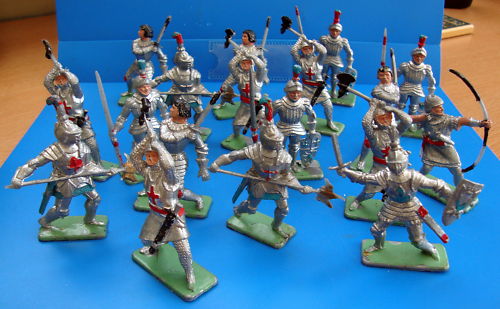
my collection.knight


 this is available from fixed bayonet at 5 pounds. contact me on the comments if required. also box of five or ten .They will come in our special wooden box for which there is no charge. you will also recieve a free painted figure. quote this post. If you order ten you get them for three fifty per figure
Subscribe to:
Posts (Atom)